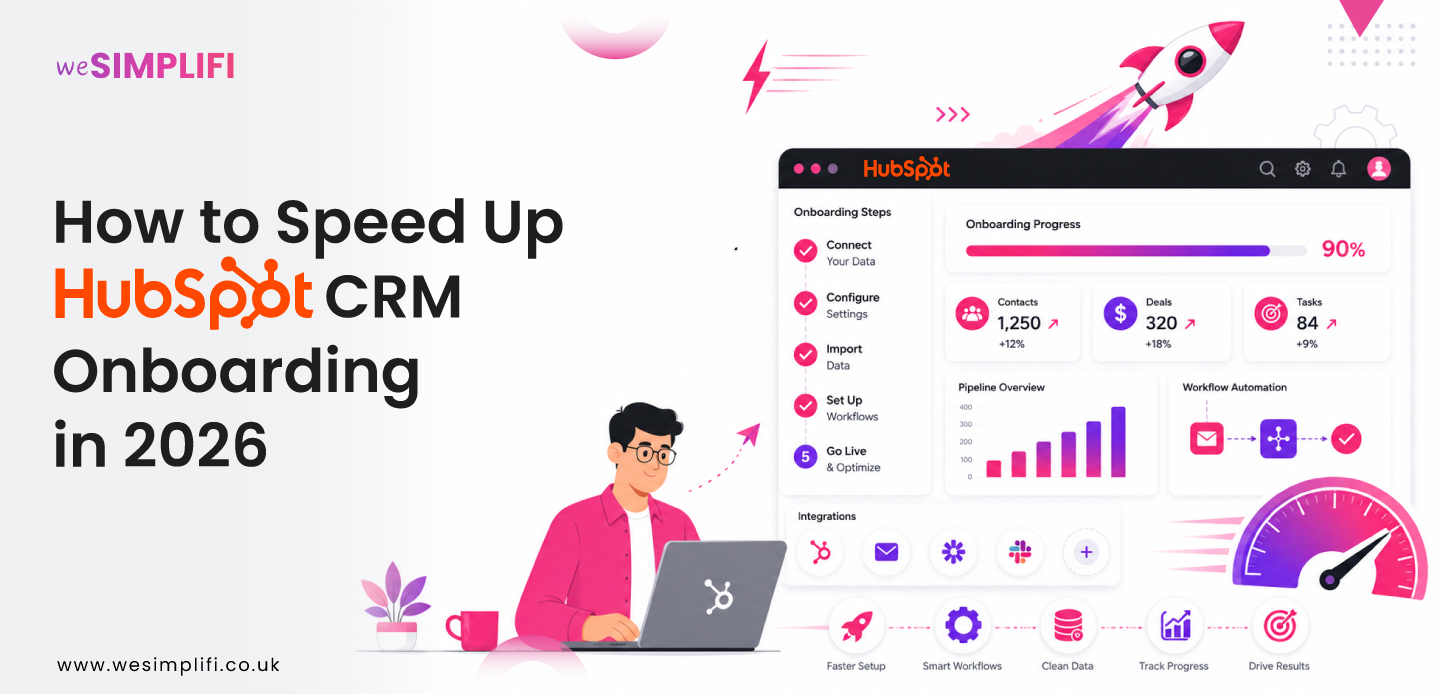
Businesses investing in the HubSpot platform often expect a faster setup and an equally faster ROI from their investment. But with poor planning, inconsistent data, or overly complex workflows, HubSpot CRM onboarding takes up longer than expected.
This delay often frustrates users, results in low adoption rates and slower ROI. That isn’t to say that you can’t overcome these challenges. With the right CRM strategy, businesses can significantly reduce their onboarding time and build a CRM that supports their long-term growth.
In this WeSimplifi guide, we'll talk in detail about the common issues that slow down HubSpot CRM onboarding and practical ways to accelerate it. We’ll also discuss when working with professional CRM onboarding services can make a difference in generating faster ROI.
Why Fast HubSpot CRM Onboarding Matters in 2026
Faster onboarding is of utmost importance in today’s competitive marketplace. It not only brings a faster set up of the platform but also reduces your time to value.
Here’s a few other benefits that faster HubSpot CRM onboarding brings:
- Accelerated CRM adoption - Lengthy legacy CRMs often take around 3 to 6 months to set up, but with fast HubSpot CRM onboarding services, your team learns the platform and adopts it quickly.
- Advanced AI optimisation - Modern AI capabilities inside the HubSpot CRM rely on clean historical data to score leads and predict churn. Fast onboarding sets up these AI tools early, allowing them to optimise your workflows sooner.
- Cross-team alignment - Treating onboarding as a marketing-only project is a common pitfall. A rapid, structured onboarding process integrates your sales, marketing, and customer service teams under one database.
- Reduces unnecessary subscription costs - As HubSpot offers per-seat pricing, teams that delay CRM implementation end up paying for seats their teams aren't even using. With faster onboarding you avoid paying for these unnecessary subscriptions.
What Slows Down HubSpot CRM Onboarding?
Before we discuss how you can ensure a fast CRM onboarding, let’s discuss what actually slows down the onboarding process.
1. Unclear CRM Strategy
Most businesses dive straight into onboarding without outlining their CRM strategy. The main purpose of a CRM is to support your business processes and without clearly documented processes,lifecycle stages, reporting requirements, or ownership responsibilities, HubSpot implementation often becomes a series of revisions. These repeated set ups extend your project timelines.
2. Dirty or Incomplete Data Migration
The quality of your data is very important for an AI-first platform like HubSpot. Migrating poor data quality with duplicate contacts, outdated companies, inconsistent deal records, or missing property values adds to your team’s burden for clean up.
It also affects your reporting accuracy, your sales and marketing automation workflows, lead scoring, customer segmentation, and even sales adoption and their productivity.
3. Lack of Sales and Marketing Alignment
HubSpot works best when marketing, sales, customer success, and revenue operations (Rev Ops) teams are aligned and work on the same/shared definitions and processes.
Without this alignment, teams often disagree on everything from lead qualification criteria, lifecycle stages and pipeline structure to the handover processes. As these disagreements frequently surface during implementation, it causes unnecessary delays.
4. Overcomplicated Automation
Automation surely is one of HubSpot’s biggest strengths but many teams make the mistake of overautomating their processes. Building every workflow before launch often slows onboarding dramatically.
A phased approach delivers value much faster while also reducing the complexity of your HubSpot implementation.
5. Limited User Training
Training your team on how to use the CRM and how exactly it fits in and simplifies their day-to-day operations is vital for complete CRM adoption. Without this structured training, users often go back to using their old spreadsheets, or enter inconsistent data, ignore required fields, or even resist CRM adoption altogether.
Role-based training should therefore be a part of HubSpot onboarding and shouldn’t happen after the platform goes live.
A HubSpot Onboarding Partner streamlines everything for you from the platform setup and configuration to user training so you don’t have to worry about anything.
5 Proven Ways to Speed Up HubSpot CRM Onboarding
At WeSimplifi, we offer complete HubSpot services from HubSpot CRM onboarding, HubSpot implementation, CRM and ERP integration, customised integrations, and managed HubSpot services. With our experience and expertise, we’ve compiled a list of five proven methods to speed up your onboarding. These include:
1. Build a Clear CRM Strategy Before Implementation
The fastest HubSpot CRM implementations begin with a well-defined CRM strategy. Before configuring HubSpot, define clear business goals that you want the platform to achieve such as reducing the sales cycle or improving your lead conversion rates.
Also, map out the entire customer journey from the first interaction to a closed deal, define consistent deal stages, and assign a dedicated project owner to oversee your CRM implementation. This clear roadmap minimises any delays, reduces rework, and ensures that the CRM is configured to support your business objectives from the beginning.
2. Prepare and Migrate Clean CRM Data
Data quality has a direct impact on your onboarding speed and long-term CRM performance. So, before migrating to HubSpot, audit your existing data to remove duplicate contacts, outdated records, and invalid email addresses. Standardise information such as phone numbers, company names, and locations and then map your existing fields to the correct HubSpot properties.
It is also suggested to run a small test import before migrating your complete database. It will help you to identify potential issues early, ensuring a smoother transition with minimal disruptions
3. Align Sales, Marketing, and RevOps Teams
Successful CRM onboarding depends on strong sales, marketing and Rev Ops alignment. This includes defining shared definitions for key stages such as what qualifies a Marketing Qualified Lead (MQL) or Sales Qualified Lead (SQL), and establishing service-level agreements (SLA) for lead follow-up.
You should also create a unified reporting dashboard so every team gets visibility into pipeline performance. Holding regular cross-team meetings will also help to resolve issues quickly and keep everyone aligned throughout the CRM implementation process.
You can also check out our expert guide on sales and marketing alignment during CRM onboarding to learn more.
4. Configure HubSpot in Phases and Train Users
Some businesses believe that using every HubSpot feature at once will reduce their onboarding timeline but in reality it can slow implementation and overwhelm the users. It is better to launch the CRM by setting up essential pipelines and core functionality first and then introduce sales and marketing automation workflows and other advanced features in stages.
You should also pair each rollout with role-specific training so employees learn the tools that are relevant to their work. You can also supplement their training with HubSpot Academy courses and internal playbooks to help your teams adopt the platform confidently and consistently.
5. Monitor Adoption and Optimise with CRM Onboarding Services
Unlike what most believe, CRM onboarding doesn't end as soon as your system goes live. It is important to continuously monitor CRM adoption by tracking user logins, data quality, and overall platform usage to identify the areas where your employees might need additional support.
For organisations with more complex requirements, it is wise to partner with a HubSpot Partner agency as they can accelerate their optimisation, improve adoption, and ensure that the CRM continues to scale with their growth.
You can also check out our guide on 7 steps to HubSpot Onboarding services to learn how WeSimplifi sets up your entire HubSpot platform.
HubSpot CRM Onboarding Timeline: What to Expect
While HubSpot CRM onboarding is a simple process, the timeline of your onboarding project varies. It depends on the complexity of your business processes, whether you are migrating from another CRM/ a legacy system, and your integration and customisation requirements.
Smaller businesses may complete their onboarding within two to four weeks, while larger organisations with multiple teams, complex integrations, or custom workflows often require six to twelve weeks.
HubSpot CRM Onboarding Checklist
While you can use the onboarding services of a HubSpot Solutions Partner, you can also undertake this project yourself through HubSpot’s self-onboarding services where you set up the platform yourself and HubSpot assists you remotely.
If you’re trying this DIY onboarding, here’s a simple CRM onboarding checklist for you to confirm whether you’ve done everything right.
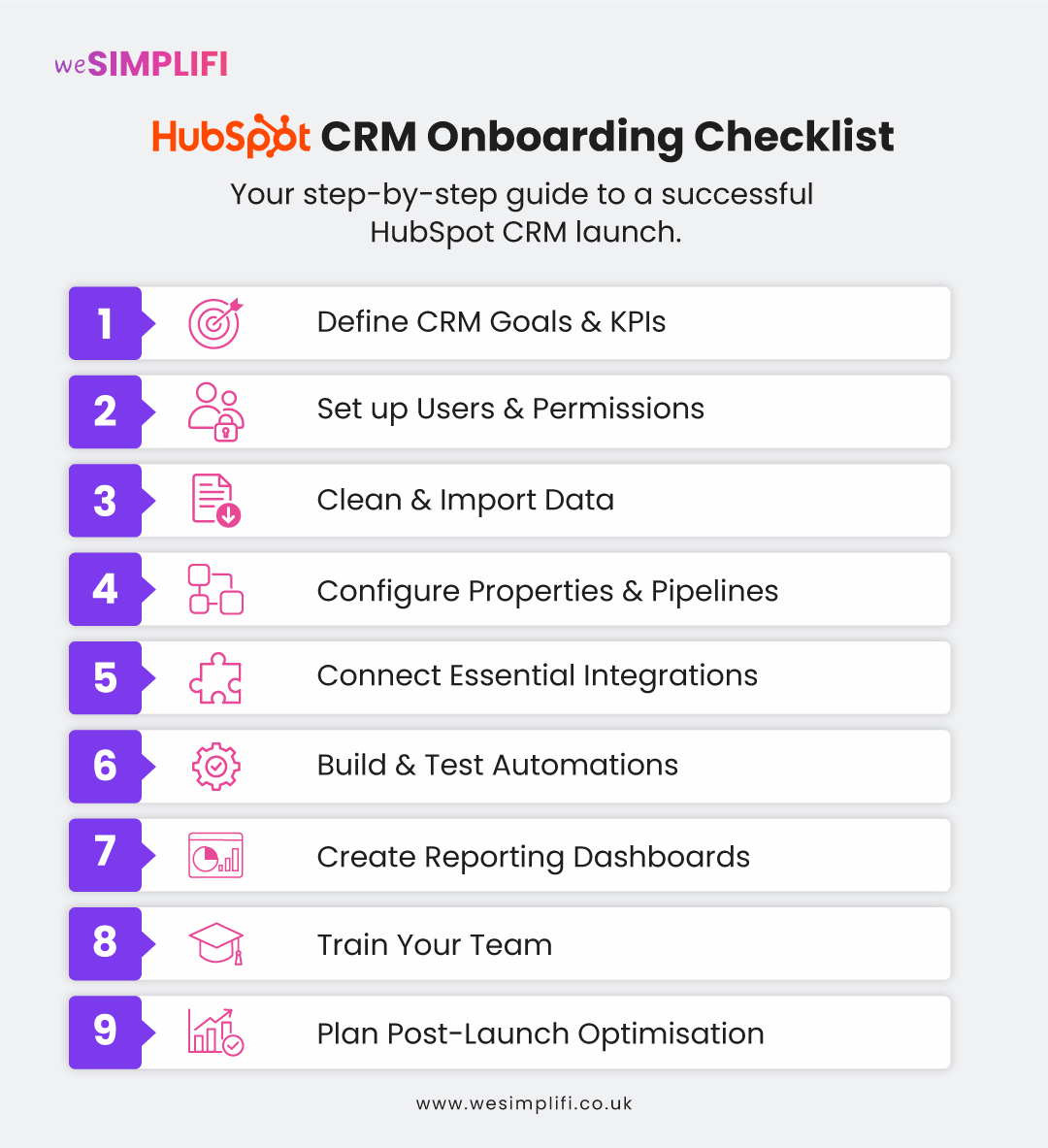
Before launching your HubSpot CRM, ensure that you have completed the following:
- Defined your CRM goals and KPIs
- Set up the HubSpot account and user permissions
- Cleaned and validated data before migration
- Mapped custom properties and configured your sales pipelines
- Connected the required apps through HubSpot integrations
- Built essential workflows and tested automation
- Created reporting dashboards
- Given role-based training to all HubSpot users
- Outlined a post-launch optimisation plan
Completing these steps helps to reduce CRM onboarding and implementation risks, improving marketing and sales adoption, and your ROI.
KPIs to Measure CRM Onboarding Success
Most businesses set up the HubSpot platform once and then forget about it. This is exactly where they go wrong, using HubSpot brings the maximum value when it is optimised over time.
You should measure key performance metrics like:
- Time to Productivity
- Lead Response Time
- Pipeline Accuracy
- Consistency of logging activities in the CRM
- Time-to-First-Action (TTFA)
- Daily/Weekly Active Users (DAU/WAU)
Measuring these KPIs and your business metrics is important to measure the true success of your onboarding instead of just tracking project completion.
When Should You Hire CRM Onboarding Services?
While HubSpot is designed to be user-friendly, many organisations benefit from working with CRM onboarding specialists.
Professional onboarding services are particularly valuable when you’re:
- Migrating from multiple CRM systems
- Managing large contact databases
- Building advanced automation workflows
- Integrating third-party software
- Implementing complex sales processes
- Supporting multiple business units
- Requiring advanced reporting and dashboards
- Lacking in-house HubSpot expertise
These experienced CRM consultants can help businesses to avoid common implementation mistakes, accelerate marketing and sales adoption, and ensure that CRM supports their future growth rather than requiring costly rework.
Takeaway
Fast onboarding doesn’t just mean a shorter timeline but creating a CRM setup that reflects how your business works and your teams can actually use it daily.
This fast adoption starts with a clear CRM strategy, clean data, cross-functional sales and marketing alignment, phased implementation, and continuous optimization leading to faster ROI and stronger business outcomes. An experienced HubSpot CRM onboarding partner can help you with everything from the platform setup, its configuration to training your teams and platform optimization.
Get in touch with WeSimplifi to reduce onboarding time while maximising the long-term value of your CRM.
Frequently Asked Questions
1. Should small businesses invest in CRM onboarding services?
Yes, small businesses should invest in CRM onboarding services if they don’t have a HubSpot expert on their team. Seeking professional help gets you faster time to value and align the CRM with your business processes and goals.
2. What is the fastest way to onboard HubSpot users?
The fastest way to onboard HubSpot users is to set up the platform right the very first time. It starts with your CRM strategy, defining your CRM goals, configuring the platform to your processes, and role-based training to ensure complete adoption.
3. What is included in CRM onboarding services?
CRM onboarding services include the entire set up of the platform. This includes everything from the initial consultation for CRM strategy, data migration, customising the CRM system (like setting up pipelines and workflows)and role-based training of your team to the post-launch optimization support. This helps to ensure a high user adoption and ROI.
4. What are the steps in the onboarding process?
The steps included in the HubSpot onboarding process are:
- Defining CRM goals.
- Setting up the HubSpot platform and user permissions.
- Auditing data quality, cleaning and standardising it before CRM migration.
- Building sales pipelines and automation workflows.
- Role-based user training.
5. What are the four pillars of HubSpot onboarding?
The four core pillars of HubSpot Onboarding are strategic clarity, clear roadmap, effective setup, and team adoption. This helps ensure that the platform is set up right the first time.
-1.jpg)