Sales and marketing teams have always worked independently. But as the buyer journey became more complex and non-linear, organisations recognised the need for a clear alignment between the two teams.
Today, the RevOps systems combine marketing, sales, and customer services in a single platform to bring faster deal cycles, more predictable revenue, and better customer experiences.
A platform that has become central to facilitate this alignment is a CRM system which provides a single view of all customer data and interactions. But this alignment doesn’t begin once you start using the CRM, it begins with the CRM onboarding process.
In this article, WeSimplifi breaks down the strategy for ensuring sales and marketing alignment during CRM onboarding. We’ll cover the benefits of this alignment, the key CRM features that support it, and the best practices for building a connected RevOps system in 2026.
Signs Your Sales and Marketing Teams are Misaligned
Most companies struggle because of their misaligned marketing and sales teams which directly affects their revenue, increases customer acquisition costs, and damages the buyer experience.
Understanding the signs of misalignment is crucial before beginning to fix it. The common signs that indicate a broken sales and marketing alignment include:
- Separate definitions of an Ideal Customer Profile (ICP), Marketing Qualified Lead (MQL), and Sales Qualified Lead (SQL).
- Marketing teams have no visibility into what happens to a lead after the handoff to sales.
- Prospects receive different messaging from sales and marketing teams.
- Sales teams often complain about lead quality.
- Both teams work on separate systems that don’t connect.
A CRM bridges this gap by bringing all customer data, processes, and communication systems into a single platform. When implemented strategically, CRM onboarding can help your sales and marketing teams to work more effectively toward common revenue goals.
Benefits of Aligning Sales and Marketing during CRM Onboarding
Aligning sales and marketing during CRM onboarding creates a unified view so both teams work from the same customer data, processes, and goals. This makes customer acquisition and revenue growth much easier for any organisation.
The key benefits of this alignment includes:
- Improved quality of leads
- Better visibility across the buyer journey
- Consistent customer experience
- Faster lead handoffs
- More accurate reporting
- Data-driven decision making
Key Steps to Achieve Sales and Marketing Alignment in CRM Onboarding
The CRM onboarding process is an important first step towards ensuring successful sales and marketing alignment.
The key steps to achieving alignment in CRM onboarding includes:
Define a shared Ideal Customer Profile (ICP)
Begin by defining the characteristics of your target customers. This includes factors such as industry, company size, business challenges, and decision-maker roles. With this shared ICP both teams will work on attracting and converting the right prospects.
Establish clear lead qualification criteria
One of the most common causes of friction is disagreement over lead quality. During the onboarding process, create clear definitions for:
- Marketing Qualified Leads (MQLs)
- Sales Qualified Leads (SQLs)
- Opportunity stages
- Lead handoff requirements
Documenting these definitions within the CRM will promote consistency and accountability.
Map the customer journey
Before configuring your pipelines and workflows, your teams should map out the entire customer journey - from initial awareness to closed deal. This will help to identify key touchpoints, ownership responsibilities, and potential gaps in your processes.
Create shared goals and KPIs
Creating shared goals or KPIs improves alignment as it’s easier to work towards the same objectives. You should also track shared metrics such as conversion rates, customer acquisition cost, revenue attribution, and customer lifetime value for optimisation of your processes.
Automate lead routing and follow-ups
Automation can be used to streamline lead routing, follow-up activities, lifecycle stage updates, and internal notifications. Creating well-designed workflows ensure that prospects move efficiently through the funnel without relying on manual processes.
Your in-house CRM expert will ensure that this approach fosters better collaboration between your sales and marketing teams. Many organisations also benefit from the expertise of CRM onboarding services so the CRM is configured to scale right from the start.
CRM Onboarding Best Practices for Sales and Marketing Teams
Unlike what most believe, a successful CRM project requires more than just technically sound CRM implementation. It also involves designing shared processes, CRM training and adoption, and ongoing collaboration between your teams.
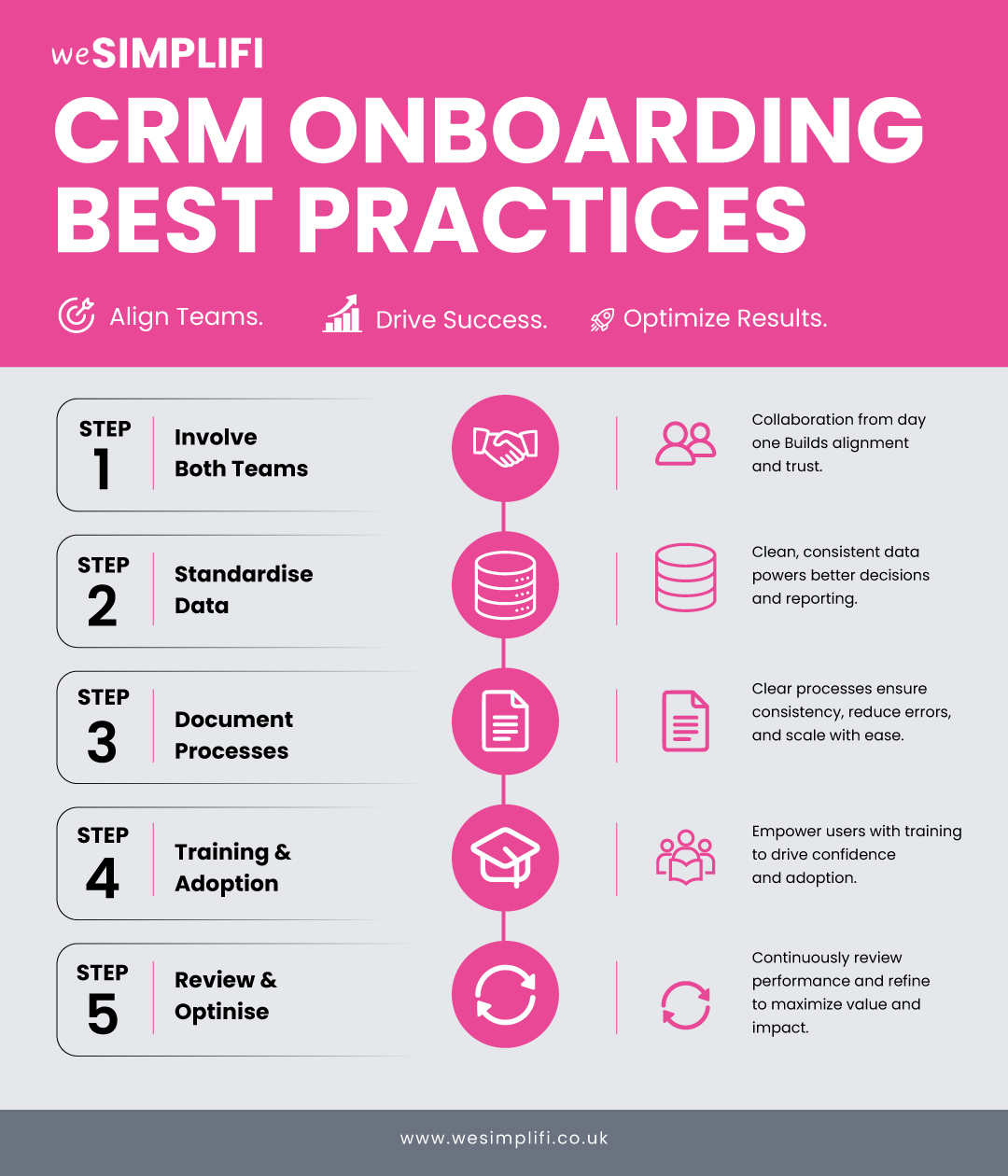
Some recommended CRM Onboarding best practices include:
- Involve both sales and marketing teams early in planning sessions, workflow discussions, and CRM configuration decisions. This early involvement ensures that the system supports the needs of both teams.
- Standardise data management by establishing consistent naming conventions, required fields, data entry standards, and management of duplicate data. This ensures clean data which further improves your reporting and reduces operational inefficiencies.
- Document your processes clearly including lead management procedures, qualification criteria, ownership rules, and reporting requirements. This helps to maintain consistency as your teams grow.
- Prioritise CRM training and adoption by providing role-based training. This supports your employees to adopt new workflows and follow established processes
- Review and optimise regularly, identify workflow bottlenecks, data quality issues, and opportunities for process improvements.
If you are looking for the 10 best CRM onboarding practices for mid-sized teams, check out our previous article.
Common CRM Onboarding Mistakes that Hurt Alignment
Organisations often invest in CRM platforms expecting to see immediate results. But measurable results take time and sometimes certain onboarding mistakes can create new challenges instead of improving alignment.
Some common mistakes that you must avoid are:
- By not defining shared goals, your CRM will reflect this disconnect between teams, leading to inconsistent processes, conflicting priorities, and reporting gaps.
- Migrating poor-quality or duplicate data into the CRM, makes it difficult for your teams to rely on customer information for decision-making.
- Overcomplicating workflows during onboarding can create confusion for users. It further slows down CRM adoption and introduces unnecessary friction into the lead management process.
- Failing to establish clear definitions for MQLs, SQLs, lifecycle stages, and lead ownership can result in miscommunication and inefficient lead handoffs.
- Neglecting user training often leads to inconsistent CRM usage, incomplete data entry, and reduced collaboration across teams.
- Configuring the CRM without input from both sales and marketing teams creates processes that support one function while limiting the visibility and efficiency for the other.
- Treating onboarding as a one-time CRM implementation rather than an ongoing business process prevents you from identifying improvement opportunities and adapting to changing business needs.
By taking these mistakes into consideration while planning your onboarding process, you can create a scalable system that supports your revenue operation.
Essential CRM Features that Support Sales and Marketing Alignment
Modern CRM platforms like HubSpot help sales and marketing teams work together efficiently by creating a single source of truth. The HubSpot CRM onboarding not only supports mid-sized tech companies but complex sales pipelines and startups too.
The CRM features that support the alignment between sales and marketing teams are:
Centralised contact database
A shared customer database ensures that both teams have access to the same contact records, communication history, and engagement data.
Lead scoring
Lead scoring helps prioritise prospects based on factors such as demographic fit and engagement behavior, creating a more consistent qualification process.
Lifecycle stage management
Lifecycle stages provide visibility into where contacts are within the buyer journey and help maintain alignment across teams.
Marketing and sales automation
Automation tools support lead nurturing, follow-up reminders, task assignments, and workflow management while reducing manual effort.
Closed-loop analytics and reporting
Shared dashboards allow both teams to monitor performance, track pipeline progression, and measure revenue-related outcomes using the same data source.
Not sure where to begin? Contact WeSimplifi to tailor the HubSpot CRM around your processes and goals.
Measuring the Success of Sales and Marketing Alignment
No CRM onboarding or implementation is complete without an evaluation of whether the alignment efforts are actually producing results. Creating reporting and reviewing metrics regularly is crucial to refine your workflows and boost your ROI.
Some common metrics that you should track are:
- Lead-to-MQL conversion rate
- MQL-to-SQL conversion rate
- Opportunity creation rate
- Length of your sales cycle
- Customer acquisition cost (CAC)
- Marketing-sourced pipeline
- Revenue attribution
- Customer retention metrics
In addition to these performance metrics, businesses should also gather feedback from both sales and marketing teams to identify process challenges and improvement opportunities.
Such regular reviews help to ensure that your alignment efforts continue to support your evolving business goals.
Future Trends in CRM Onboarding and Team Alignment for 2026
As CRM platforms continue to evolve, organisations are moving beyond basic contact management. CRM onboarding in 2026 will focus on creating connected revenue operations that align sales, marketing, and customer success teams around a shared customer view.
The key trends for CRM onboarding and team alignment in 2026 are:
AI-powered CRM onboarding and automation
Modern CRM platforms are increasingly using AI to assist with lead scoring, workflow recommendations, forecasting, content generation, and customer engagement. Your onboarding strategies should ensure that these tools are supported by accurate and well-structured CRM data.
Greater adoption of Revenue Operations (RevOps)
Instead of siloed sales and marketing processes, businesses are using RevOps frameworks that connect teams through shared data, workflows, and performance metrics. CRM onboarding in 2026 will increasingly focus on supporting end-to-end revenue visibility rather than individual departmental goals.
Stronger emphasis on unified customer data
Organisations are prioritising centralised data management to eliminate fragmented customer information across multiple systems. Future CRM onboarding projects will place greater importance on creating a single source of truth that supports both human teams and AI-driven insights.
Growing reliance on first-party data
As privacy regulations evolve and third-party tracking becomes less reliable, businesses are increasingly using first-party customer data collected through CRM platforms. This shift will make data quality, governance, and consent management important considerations during onboarding
Hybrid human-AI workflows
Rather than replacing employees, AI is being integrated into everyday sales and marketing activities to improve efficiency and decision-making. CRM onboarding in 2026 will involve designing workflows where AI assists with repetitive tasks while teams focus on building relationships and strategic initiatives.
By adopting these trends early, you can build CRM systems that not only improve your sales and marketing alignment today but also supports your future growth, scalability, and customer expectations.
Takeaway
Sales and marketing alignment is no longer optional but a critical component of successful CRM onboarding and long-term revenue growth.
When sales and marketing work from the same data, goals, and workflows, businesses deliver consistent customer experiences and drive sustainable growth. CRM platforms such as HubSpot provide the necessary tools to support this alignment, but success ultimately depends on how well your teams collaborate throughout the onboarding process.
At WeSimplifi, we support your teams with our tailored CRM onboarding services and offer ongoing support to ensure the CRM is configured for scalability. Get in touch with us to leverage our HubSpot CRM onboarding services.
Frequently Asked Question
1. What is the alignment of marketing and sales?
The alignment of marketing and sales enables both teams to work from the same data, with the same goals and target audience. This streamlines the buyer journey and drives measurable revenue growth.
2. What are the 5 P's in sales and marketing?
The 5 P's in sales and marketing are - Product, Price, Promotion, Place, and People. These form the basis of building and executing a successful go-to-market strategy.
3. What KPIs should sales and marketing teams share in a CRM?
Sharing key KPIs in a CRM, promotes better sales and marketing teams alignment. Examples of such KPIs are:
- Lead-to-Opportunity Conversion Rate
- Average Sales Cycle Length
- Customer Acquisition Cost (CAC)
- Customer Lifetime Value (LTV)
- Pipeline Velocity
4. How does CRM onboarding improve sales and marketing alignment?
CRM onboarding improves sales and marketing alignment by providing a single, shared view of all customer data. As teams work from the same data, on the same goals, this alignment leads to data-driven revenue growth.
5. How can businesses increase CRM adoption across teams?
Businesses can increase CRM adoption across teams by providing role-based training, ongoing support, incentivising adoption, and establishing internal SLAs.
6. What CRM features are most important for sales and marketing collaboration?
The CRM features that are most important for sales and marketing collaboration include:
- Shared view of the buyer journey
- Closed-loop lead scoring and tracking
- Automated lead handoff
- Unified dashboards for reporting
- Shared workflows and communication