Modern marketing teams aren’t struggling because they lack tools, they’re struggling because their tools don’t communicate with each other. Between disconnected CRMs, manual workflows, and underused automation, most teams leave 30-50% of their growth potential on the table.
That’s where the combination of AI and HubSpot can be the turning point.
By combining intelligent automation with clean, scalable CRM architecture, businesses can save up to 10 hours per week, improve their lead conversion, and align their marketing, sales, and operations into a seamless growth system.
In this WeSimplifi guide, we break down the four proven best practices that modern marketing teams can use to integrate AI with HubSpot marketing automation. These strategies will help you eliminate your bottlenecks, scale faster and turn your tech stack into a revenue driver.
Understanding AI in HubSpot Automation
AI in HubSpot marketing automation utilises the platform’s built-in AI features to align sales, marketing, and service teams around a single, unified source of truth.
Instead of relying on manual processes and guesswork, these modern teams can use AI to analyse their customer data, predict behaviour, and trigger more personalised interactions.
These AI capabilities in HubSpot are unified under the Breeze umbrella, consisting of Breeze agents and Breeze assistants. This AI by HubSpot can power your everyday tasks from content generation, predictive lead scoring, and chatbots, to workflow automation.
Breeze connects the generative AI with your CRM data, so every interaction whether it’s a marketing email, sales follow-up, or customer support response is informed by real-time insights. This results in an intelligent automation, so your CRM doesn’t just store data but helps you act on it.
Why Combine AI with HubSpot for Marketing Success
AI and HubSpot are both powerful tools in their own right but together they solve one of the biggest problems that modern marketing teams face i.e., disconnected data and inefficient execution.
When AI is integrated into HubSpot’s marketing automation, marketing teams can turn their scattered data into actionable insights. These insights remove the guesswork from workflows to enable faster, data-driven decisions, improving both campaign performance and overall productivity.
Here’s why this combination of AI + marketing automation in HubSpot works successfully:
- It creates a unified data foundation where HubSpot centralises all your data and Breeze turns it into actionable insights.
- AI supports smarter personalisation by enabling relevant messaging at every touchpoint in the customer's journey.
- Automation improves your operational efficiency. It reduces manual work and speeds up campaign execution.
- It enables better decision-making with predictive insights, removing the guesswork from your operations.
Best Practices for Using AI + HubSpot Automation
While marketing teams are rapidly jumping on the AI bandwagon, getting real value from AI requires more than just tools. It requires a clear strategy to support marketing automation with HubSpot AI, this is where a HubSpot automation consultant can make a significant difference.
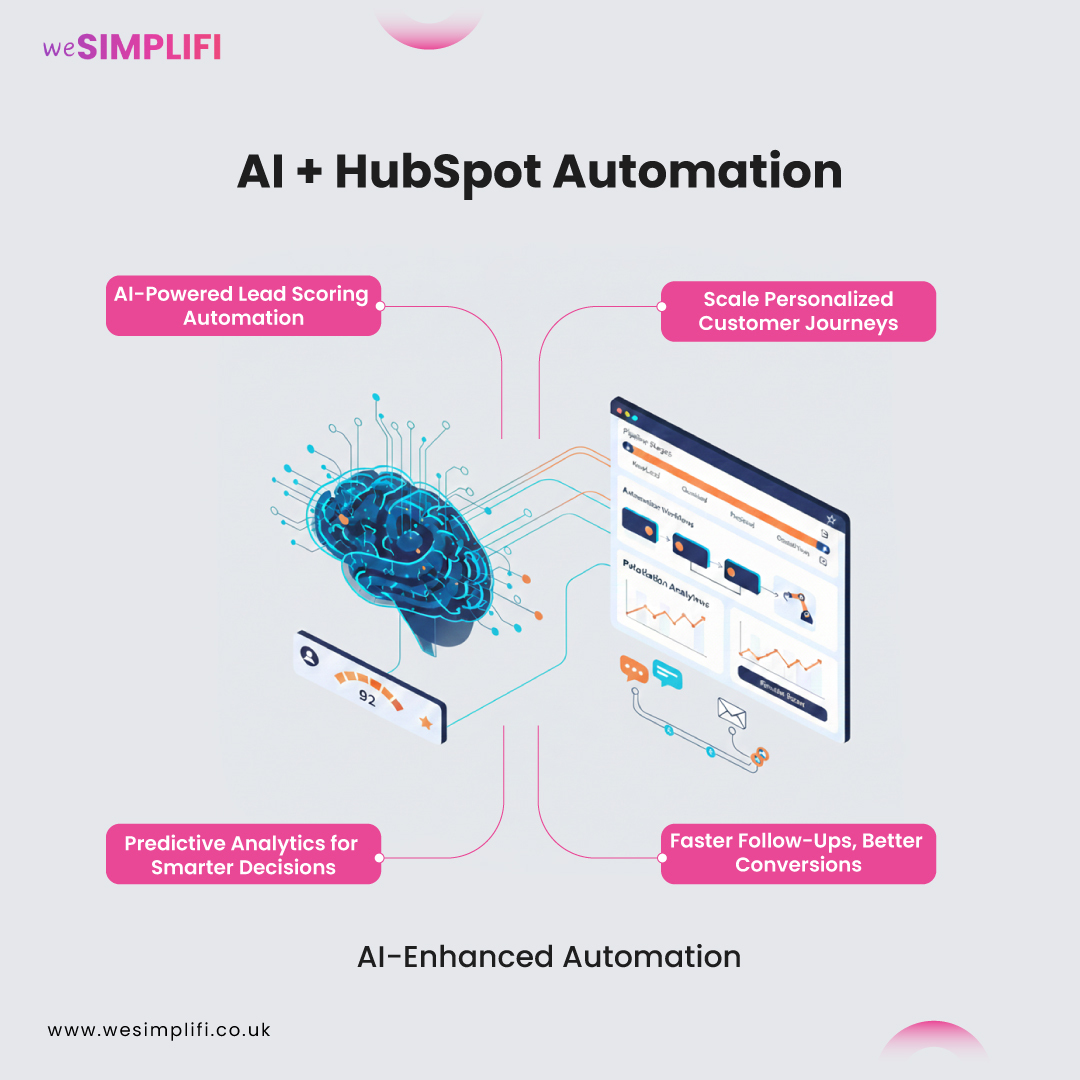
At WeSimplifi, our consultants have supported countless businesses to turn their disconnected systems into structured, AI-driven HubSpot environments.
Here’s a list of our best practices to help you use AI within HubSpot to drive measurable results:
1. Automate Your Lead Scoring with AI Intelligence
Manual lead scoring is not only time consuming but is often inconsistent and becomes outdated pretty quickly.
AI simplifies this task by prioritising your leads based on real behavioural and historical data, ensuring your sales teams focus only on the prospects most likely to convert. This improves their efficiency throughout the funnel and reduces wasted effort on low-intent leads.
2. Personalise Your Customer Journeys at Scale
The buyers today don’t want a generic outreach, they expect personalised and timely communication at every stage of their journey.
AI supports you here to build dynamic customer journeys that adapt based on user behaviour, engagement, and lifecycle stage. So, instead of sending the same message to everyone, you deliver tailored experiences that increase your engagement and shorten the sales cycle.
3. Use Predictive Analytics for Better Decision Making
Instead of relying only on the insights about your past performance, AI enables your teams to make progressive decisions using predictive analytics.
From identifying your high-converting segments to optimising your campaign timing, these predictive insights help you to act proactively, improving both the speed and accuracy of your marketing strategy.
These insights become even more powerful when they are combined with scalable SaaS workflow automation systems that adapt as your business grows.
4. Automate Your Follow-Ups & Sales Handoff
One of the biggest gaps in marketing is what happens after a lead converts. Without clear hand-offs and nurturing sequences many leads never turn into sales.
AI-driven automation ensures that these leads are followed up instantly and routed to the right teams through well-structured marketing automation workflows. This creates a seamless hands-off between marketing and sales, improving your response times and increasing your close rates.
How HubSpot AI (Breeze) Makes This Possible
The best practices listed above define what high-performing teams do. The next step is the execution, i.e., how you can actually implement these inside HubSpot.This is where Breeze, HubSpot’s built-in AI features, come into play. Breeze helps turn these strategies into action, through:
Predictive Lead Scoring
It enables smarter lead prioritisation by automatically identifying which of your prospects are most likely to convert. This supports your lead scoring strategy without requiring much manual effort.
AI Content Assistant
It helps you scale personalised content across emails, landing pages, and campaigns, making it easier for you to build tailored customer journeys.
Conversational AI & Chatbots
These capture and qualify leads in real time, ensuring faster response times and supporting seamless handoffs to sales.
Smart Automation Workflows
Use behavioural triggers to automate follow-ups, nurture sequences, and internal processes, so your funnel moves effortlessly without manual input.
AI-Driven Insights & Recommendations
Provide guidance on the next steps, helping your teams make better decisions based on real-time data and predictive signals.
Campaign & Email Optimisation
Improve your campaign performance with AI-backed recommendations on timing, messaging, and structure. This enhances your results without requiring constant testing.
Not sure where to start? Utilise, WeSimplifi managed HubSpot services to build a fully aligned and scalable growth system for your business.
AI + HubSpot Automation Mistakes to Avoid
Now that you have the clarity on how AI and marketing automation can be combined in HubSpot to create a scalable growth engine for your business. Let's, take a look at some common mistakes that most businesses make.
These mistakes are what often stalls business growth even when your teams have the right tools in place:
1. Ignoring Real-World Use Cases that Drive Results
Most teams adopt AI because it’s trending, not because they have a clear use case in mind. The result? They end up creating overcomplicated systems that don’t deliver real value.
Instead of following trends, focus on the practical applications of AI, like lead scoring, email automation, and segmentation so it can directly contribute to your revenue generation.
2. Starting without a Clear Automation Strategy
Without a clear plan in place, automation creates complexity instead of efficiency. Before implementing AI in HubSpot, make sure to define your goals (related to lead generation, conversion, and retention, etc).
Outline your key workflows and success metrics, this ensures that every automation you build serves a clear purpose.
3. Failing to Prepare for the Future of AI Marketing
AI is evolving quickly and teams that treat it as a one-time setup will definitely fall behind. It is therefore important to continuously optimise your workflows and review your performance data regularly.
Staying updated with the latest HubSpot AI features helps you stay competitive too.
Conclusion
Unlike what most believe, the future of marketing isn’t about adding more tools to your tech stack, it's making sure the ones you own, work smartly. By combining AI + HubSpot automation, businesses can eliminate their inefficiencies, improve alignment, and gain scalable growth.
The real challenge today isn’t access to technology, it’s not knowing how to structure, implement, and optimise it effectively.
This is exactly where WeSimplifi comes in. We help businesses design clean CRM architectures, implement AI-driven automation, and align their marketing and sales processes. We turn HubSpot from a CRM platform to a fully integrated growth system for your business. Please reach out to our HubSpot automation consultants and book your site audit.
Frequently Asked Questions
1. How does AI enhance HubSpot automation?
AI can be used in HubSpot to automate workflows through Breeze Assistants. They help to personalize customer journeys, automate content creation, get predictive insights, and support data enrichment to automate sales, marketing, and service workflows.
2. Can AI improve lead scoring in HubSpot?
Yes, AI can improve lead scoring in HubSpot through data-driven insights. AI analyses behavioural patterns and historical data to identify high-value prospects, reducing human error, boosting conversion rates, and reducing sales cycles.
3. What marketing tasks can be automated using AI in HubSpot?
AI can be used in HubSpot to automate marketing tasks like content creation, SEO optimisation, and lead scoring, etc. It improves your campaign performance through data-driven insights and helps you design hyper personalised campaigns.
4. How does AI improve customer personalisation?
AI improves customer personalisation by using machine learning to analyse behavioral, demographic, and transactional data in real-time. This helps to deliver customised customer experiences like product recommendations, dynamic website content, and personalised messaging, etc.
5. Can AI help increase conversion rates in HubSpot?
Yes, AI can help to increase the conversion rates in HubSpot by automating personalised marketing, optimising sales outreach, and enhancing lead scoring. This can be achieved through Breeze Agents to automate workflows, generate tailored content, and engage prospects faster.
6. How quickly can teams see results from AI automation?
Results of AI automation start to show up after 1-2 weeks, while significant results can be noticed in around 2-3 months.