


For operations teams in the UK, choosing a HubSpot partner isn’t just about finding someone to configure their CRM. The right partner needs to understand how your business operates, how your teams use data, where your processes break down, and how HubSpot fits into your tech stack.
This becomes particularly important as your CRM grows more complex. For this everything inside HubSpot from workflows, integrations, reporting and data management to user adoption needs to work together instead of being treated as separate projects.
In this WeSimplifi guide, we’ll look at the eight areas that UK operations teams should assess when choosing a HubSpot partner, along with the questions to ask and the red flags to watch for.
Why Operations Teams Need more than a Basic HubSpot Setup
While there’s nothing wrong with a basic HubSpot setup as it can give you a working CRM, what operations teams need is for their CRM to support their business processes as they become more complex.
This can involve managing data across multiple teams, maintaining pipelines, automating repetitive processes, connecting external systems, and making sure leadership has reliable operational reporting. HubSpot itself supports a broad range of these functions.
UK Ops teams just need a reliable HubSpot implementation partner who can use their HubSpot services to design and maintain HubSpot around the way their business actually works, bringing long-term value to their CRM.
8 Things UK Ops Teams Should Look for in a HubSpot Partner
Before choosing the right partner for your business, here’s a list of eight important factors that you must consider:
1. A Strong Understanding of Your Business Processes
Every successful HubSpot implementation begins with an understanding of business processes and how HubSpot features can support your marketing and sales operations. Reliable UK HubSpot agencies know this and start with an audit of your processes.
They evaluate everything from your biggest manual bottlenecks, which processes need standardisation to which tools need to exchange information. They also set up relevant goals for your implementation so you can measure your progress or success.
2. Expertise across CRM and HubSpot Operations
With their complex processes, operations teams often need to work across several areas of HubSpot instead of a single HubSpot Hub. Your HubSpot partner may need to configure the CRM objects and properties, pipelines, permissions, workflows, reporting, data structures, and user processes for this.
This is where practical HubSpot expertise matters. Ask your HubSpot consulting partners how they approach the CRM as a whole rather than individual features. The right one will explain why a particular feature makes sense for your business, what its operational consequences are, and how it can be maintained as your requirements change.
3. Marketing and Sales Operations Expertise
Operations often sit between Marketing and Sales, which makes the handoff between these teams particularly important. Your partner should be able to help you define what happens at each stage of the customer journey.
For example, when does a contact become a qualified lead, when does Sales take ownership or what happens if a salesperson doesn't follow up. A strong partner will help you simplify these processes where possible rather than simply turning every process into another workflow.
4. Data Quality and CRM Management Capabilities
A well-configured CRM is only useful if you can trust the CRM data. Duplicates, inconsistent property values, missing information and unclear ownership can quickly make your HubSpot portal difficult to manage.
This is particularly important during a HubSpot CRM migration. You shouldn't just assume that every record in your existing CRM needs to be moved into HubSpot. Before migration, your HubSpot implementation partner will help you determine what needs to be cleaned, what needs to be mapped differently, and what data can be left behind.
5. Automation and Workflow Expertise
Automation can remove a lot of your repetitive work but more automation isn't automatically better. Automating a process that’s already complicated will leave you with dozens of workflows that nobody fully understands.
An experienced partner will first look at whether your sales or marketing operations can be simplified. Only then will they decide what needs to be automated and what happens when something goes wrong like when the required data is missing or how will your team know if a workflow stops working as expected.
6. Integration and Technical Capability
Operations teams often connect their CRM with their finance software, an ERP, customer service platforms, data tools or other business applications. While setting up integrations with these tools, the question isn't about connecting two systems but understanding how these systems should exchange data.
Your HubSpot agency will evaluate important factors like which platform is the source of truth, which system owns a particular field, should information move one way or both ways, and what happens when records don't match. And make these decisions before your integration is built.
7. Reporting and Operational Visibility
Before building your reports, the HubSpot consulting partner will discuss what decisions the reports need to support. For example, instead of simply reporting pipeline value, you may want to know which deals have been sitting in a stage for too long.
Similarly, instead of simply reporting the number of leads generated, you may want to understand whether qualified leads are being followed up within your agreed timeframe. For this, your reporting needs to be considered when designing the CRM architecture and shouldn’t be treated as an add-on.
8. Ongoing Support, Training and Optimisation
Your HubSpot implementation doesn't stop when the portal goes live. Your business will change as will your teams, new tools will be introduced, and your reporting requirements will evolve. This means, your partner should have a clear approach to what happens after launch.
They should include regular portal reviews, workflow improvements, reporting changes, training and technical support for continuous optimisation of your CRM. Documentation is equally important here so everyone on your team knows why a particular workflow exists or how an integration works.
You can also check our guide on how HubSpot implementation services help growing businesses for more information.
What UK Ops Teams Should Ask a HubSpot Partner before Hiring Them
You’ve gone through the list of expertise that you should expect from your partner, but if you’re considering how to make sure that your potential partner possesses them then here’s a list of questions that you should ask your HubSpot partner.
- If they’ve handled your level of complexity and stack - Ask your partner for case studies that match your data volume and legacy tools, especially if you intend to connect your HubSpot to UK-specific or enterprise ERP/accounting systems.
- If they’ve handled data hygiene and mapping - Discuss how they go about ensuring good data quality including deduplication, standardising data, and mapping fields.
- What their integration methodology is - Confirm whether they rely on native tools, HubSpot Data Sync, middleware, or custom APIs.
- Who actually owns the build post-launch - Ensure that they define clear rules for property creation, naming conventions, and permission structures so your internal ops team isn’t left with a messy portal.
- How they ensure user adoption and training - Ask for their role-specific training plans, recorded walk-throughs, and CRM onboarding process.
Having this clear discussion with your HubSpot partner will help you plan everything in advance and ensure they can support your business operations. You can check our guide to learn the complete list of questions to ask your HubSpot Partner.
Red Flags to Watch for When Choosing a HubSpot Partner
When you go through a partner’s case studies and discuss their working methodology, you’ll notice a few things. Here’s a list of some red flags that you should watch for:
- They start with configuration
If the conversation immediately moves to workflows, properties, and dashboards without understanding your processes, their CRM implementation may be technology-led rather than being business-led. - They promise to automate everything
A good partner knows not every manual process needs automation and sometimes removing a step is better than automating it. - They don't ask about your data
Data migration shouldn't just mean moving everything from your old system into HubSpot. A good partner should discuss what needs to be cleaned, changed or left behind. - They can't explain the architecture
Your partner should be able to explain how your CRM is structured and why it has been designed that way. - They have no clear post-launch plan
If their ongoing support simply involves emailing them when something breaks, you’ll struggle to keep your portal optimised as your business evolves. Ask if they’ll assign you a client success manager as we do here at WeSimplifi. - They focus on speed over adoption
Getting HubSpot live quickly doesn't mean the implementation has been successful. Your teams still need to understand the system and use it consistently.
At WeSimplifi, we understand the importance of collaborating with a business to discuss their processes, goals, and how their teams work. We design your CRM based on this discussion to build a system that scales with your business.
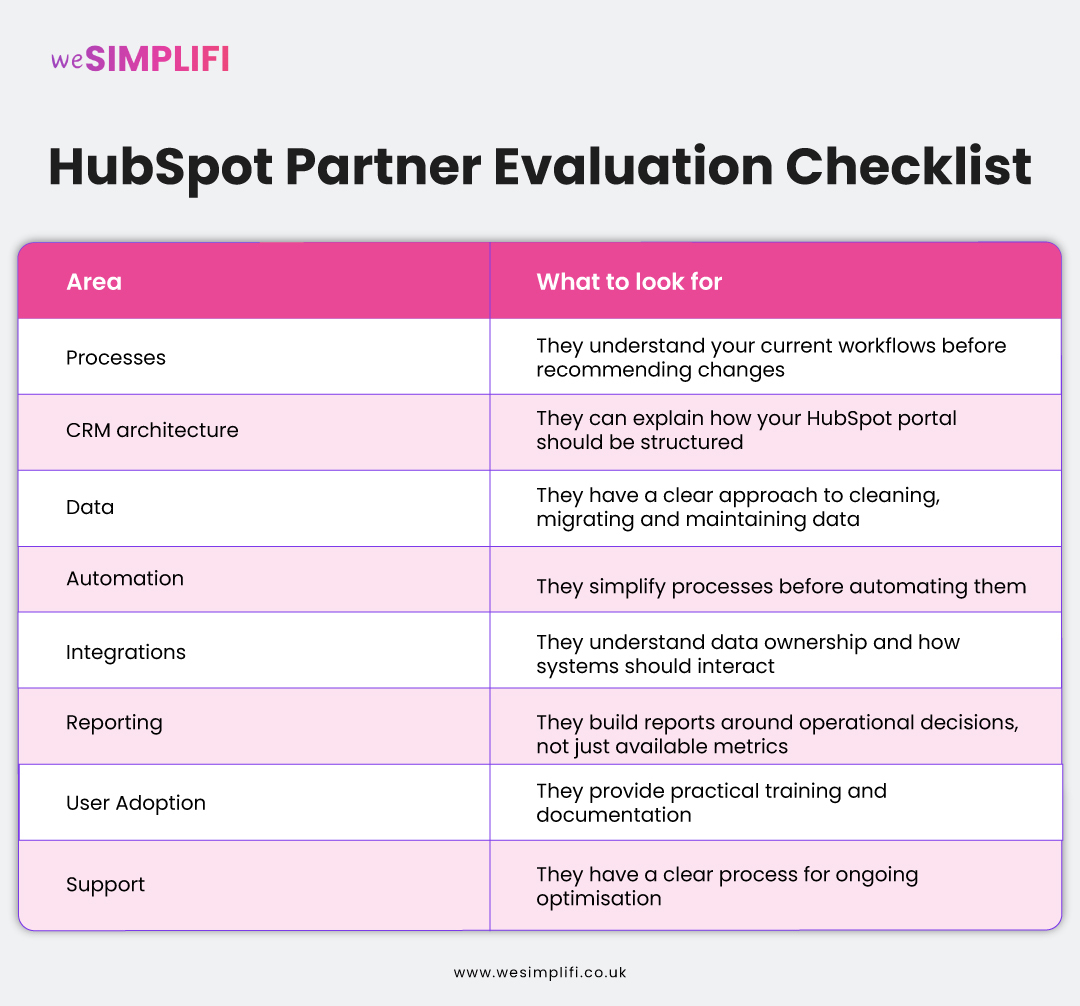
A Simple HubSpot Partner Evaluation Checklist for Ops Teams in the UK
We’ve compiled a simple tabulated list below to sum up our discussion. It contains a simple checklist that you can use to evaluate your potential HubSpot Partners and select the right one.
Why WeSimplifi Is Built for Operations-Led HubSpot Growth
At WeSimplifi, we don't see HubSpot implementation as a configuration exercise. Our work starts with understanding how your teams operate, where information moves between systems, and where manual processes create friction.
From there, we help build the CRM foundation around your business, from CRM configuration and data migration to automation, integrations, reporting and user adoption. Our process doesn’t just end there, we also think about what happens after implementation.
We document the system, train your team and continually look for opportunities to improve how HubSpot supports your operations. Our goal is to give your Ops team a system that works the way your business works and scales alongside you. Contact WeSimplifi to discuss what we can build for your Ops teams.
Frequently Asked Question
1. What does a HubSpot partner do?
A HubSpot partner helps you set up the CRM platform, right from designing it around your processes, migrating old data after cleaning it, and setting up automations and reporting dashboards to simplify your operations.
2. How do I choose the right HubSpot implementation partner?
To choose the right HubSpot implementation partner, discuss with them their CRM onboarding and implementation process, and check if they have prior experience of working with business industry and complexity like yours.
3. What should I look for in a HubSpot consulting partner?
While looking for a HubSpot consulting partner, beyond their technical expertise, look how they design the CRM around your business processes, ensure quality of data during migration, connect your tech stack with HubSpot, and ensure complete user adoption.
4. How much does HubSpot implementation cost?
Your HubSpot implementation costs vary depending on whether you’re onboarding the CRM yourself or working with a HubSpot Partner Agency. For DIY or self-onboarding you need to pay a mandatory one time HubSpot onboarding fee that ranges from $1500 to $7000 depending on which and how many Hubs you purchase. Your implementation partner can negotiate and adjust this amount in the setup they create for you.
5. Does a HubSpot partner provide ongoing support?
Yes, HubSpot Partners like WeSimplifi offer ongoing support to train your teams, troubleshoot any issues, or offer strategic guidance.
6. Can a HubSpot partner integrate HubSpot with our existing systems?
Yes, a HubSpot partner can integrate the HubSpot with your existing systems like apps through HubSpot APIs, marketplace apps, or migrate data securely from your old systems.